What is Reputation Management?
Reputation management is the practice of monitoring and influencing how people perceive a person, brand, or business online. In SEO, it means shaping the search results for your name: publishing and promoting positive, accurate content so it outranks negative reviews, complaints, or misleading coverage. It’s also called online reputation management (ORM).
More About Reputation Management
Reputation management covers everything a searcher sees when they look up your name: organic listings, reviews, business profiles, news coverage, and the knowledge panel on the search results page. Most of that space belongs to sites you don't control, which is why the work is part SEO, part PR, and part customer service.
How reputation management works
The work follows a repeatable sequence:
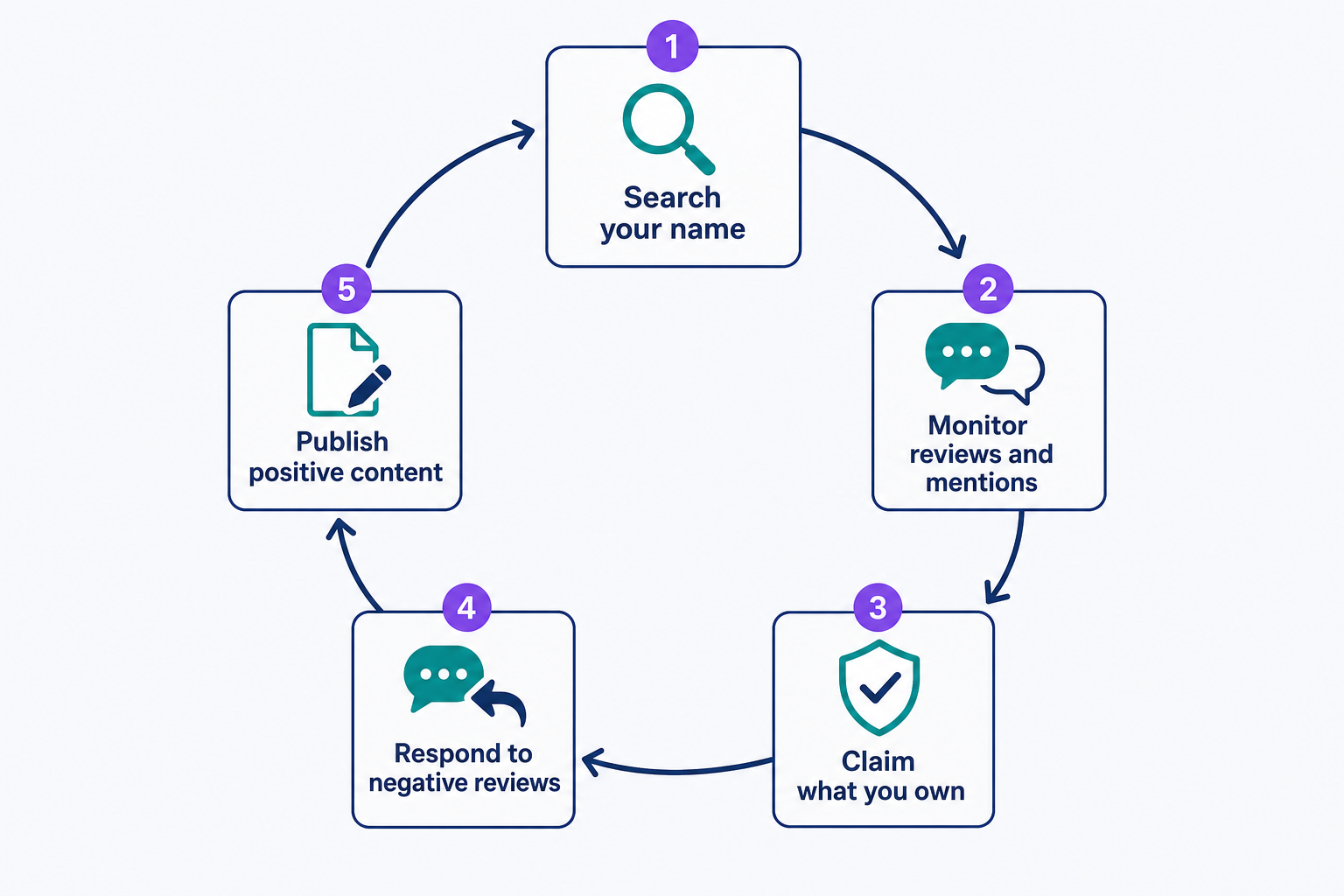
- Search your own name. Look up your brand in a private browsing window and note anything on page 1 that's negative, outdated, or wrong.
- Monitor reviews and mentions. Watch your Google Business Profile and the review sites your industry uses, and set alerts for your name. Google Search Console shows which branded searches already bring people to your site.
- Claim what you own. Complete your website, social profiles, and business listings so accurate pages exist to rank.
- Respond to negative reviews. A calm, factual reply shows every future reader how you handle problems.
- Publish positive, accurate content. Strengthen pages on your site and earn coverage elsewhere until they outrank what you can't remove.
That last step is the heart of the practice, because removal is rarely available. Getting a page taken down requires the publisher's cooperation, a policy violation, or legal grounds; in the EU and UK, GDPR's right to erasure adds a formal de-indexing request. Outranking a page requires no one's permission, which is why Reputation X's guide to search suppression (updated March 2026) treats suppression, not deletion, as the practical default.
Why outranking a bad result works
Outranking works because searchers rarely look past the first few results. Click data compiled in the same Reputation X guide shows the top 3 organic results capture 54.4% of all clicks, with 27.6% at position 1 alone, and fewer than 0.63% of searchers click anything on page 2. A result pushed off page 1 still exists, but for practical purposes it's invisible.
Say a one-star review thread ranks third for your bakery's name. It breaks no policy, and the review site won't take it down. So you build around it: a fuller about page, an active Google Business Profile, a local news feature, and 2 or 3 industry listings, each improved until it ranks above the thread. Pushed from position 3 to position 13, the thread stops shaping first impressions because it has almost no search visibility.
Reputation management vs. SEO
Both practices share tools but aim at different targets:
- SEO promotes one website for mostly non-branded searches ("custom wedding cakes") to win traffic and sales.
- Reputation management targets branded keywords, searches for your name, and works on the whole results page: organic results, knowledge panel, profiles, reviews, and images.
One gets you found; the other shapes what people conclude once they've heard of you. Reputation firm Five Blocks puts it this way: SEO gets your foot in the door and gets you noticed, while reputation management gets people coming through the door once they've heard about you.
Why reputation management matters
Reviews are the strongest trust signal a business has. DreamHost's 2026 Local Business Trust Index, a November 2025 survey of more than 1,200 U.S. consumers, found online reviews are the top credibility factor at 74%, ahead of even having a website (69%).
Expectations keep climbing. BrightLocal's Local Consumer Review Survey 2026 (published February 11, 2026) found 31% of consumers will now only use a business rated 4.5 stars or higher, up from 17% a year earlier, and AI tools such as ChatGPT have risen to third place as a source of local business recommendations. Your reputation now feeds AI answers, not just search pages.
Common reputation management mistakes
- Buying or faking reviews. The FTC's Consumer Reviews and Testimonials Rule, in effect since October 21, 2024, bans buying or selling fake reviews and carries civil penalties.
- Chasing deletion. Publishers rarely remove critical coverage, and takedown demands can draw more attention to it. Stronger positive content is usually the faster path.
- Trusting ranking guarantees. Google decides what ranks. A vendor promising page 1 in 30 days is selling a script, not a result.
Start today: search your business name, list what page 1 shows, and pick the weakest positive result to strengthen first. To find and track what people say about you, read our guide to capitalizing on brand mentions.
Frequently Asked Questions
- No flat rate exists. Cost scales with the number and authority of the negative results, the branded searches affected, and whether the work needs new content, PR outreach, review management, or legal review. Judge any proposal by the specific pages it names and the plan for each one.
- Months. Pushing a result down from the top spot means roughly 9 other credible pages must rank above it, and each needs authority that search engines take time to recognize. Plan in quarters, not weeks, and be wary of anyone who promises otherwise.
- Yes, in local search. Google lists prominence, based partly on how many reviews you have, as one of 3 main local ranking factors alongside relevance and distance, and says more reviews and positive ratings can improve your local ranking.
- Increasingly, yes. Google's AI Overviews can surface a negative page above every organic listing, and an emerging practice called generative engine optimization (GEO) shapes which sources AI models cite about you (Reputation X, March 2026). The fundamentals hold: accurate, authoritative content published where machines can find it.
Professional SEO Services
Our Pro Services team will help you rank higher and get found online. Let us take the guesswork out of growing your website traffic with SEO.
SEO Services