What is a SERP?
A Search Engine Results Page (SERP) is the page a search engine such as Google returns for a query, combining organic results with paid ads and features like featured snippets, local results, and AI Overviews. Ranking algorithms select and order the organic results by relevance and quality; ads are placed separately, ordered by advertisers’ bids and relevance.
More about SERPs
Organic search engine results generally show a title link (usually drawn from the page’s title tag), the site name and URL, and a snippet: a short summary Google builds primarily from the page’s content, using the meta description only when it describes the page better. Searchers scan those listings and click whichever looks most relevant.
Ranking algorithms score each web page’s relevance and quality to decide the order of the organic listings, and search engines refine those systems constantly through algorithm updates. Position matters more than most people expect. The #1 organic result averages a 39.8% click-through rate, versus 18.7% for position 2 and 1.6% for position 10, per FirstPageSage’s CTR meta-analysis (updated May 2025). Those figures describe pages with no extra elements like maps or shopping results, but the pattern holds: a high ranking sends far more traffic than a low one.
SERP features
A modern SERP holds far more than a list of links. Google’s Visual Elements gallery describes the results page as a set of different visual element types, and many of them answer the query right on the page:
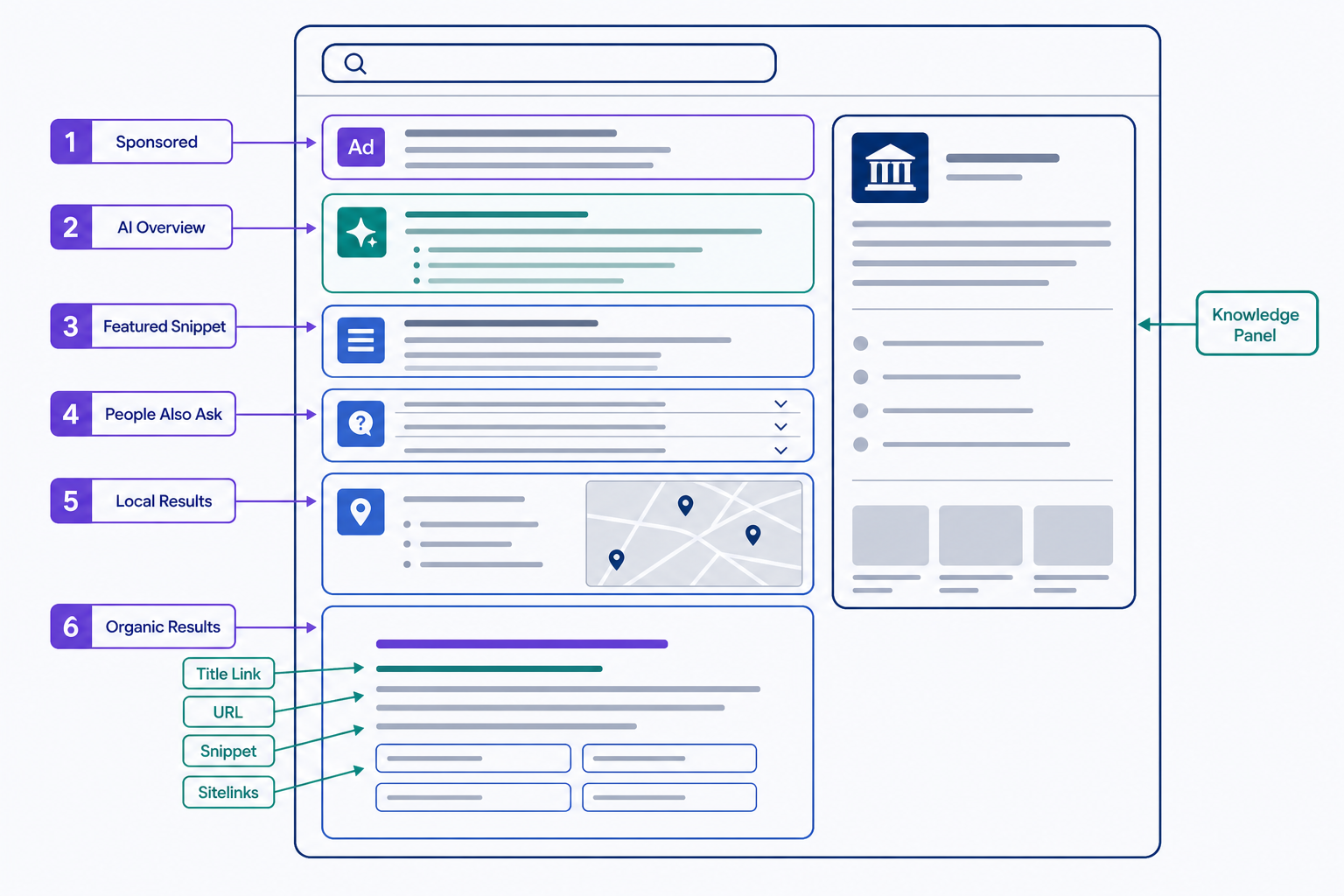
- Sponsored results: paid ads, labeled “Sponsored.” The spots are bought through an ad auction, not earned.
- AI Overviews: AI-generated summaries at the top of some results, linking out to their sources. Google says there are no additional requirements to appear in them and no other special optimizations are necessary.
- Featured snippets: an excerpt promoted from a page that already ranks, shown to answer the query directly. Our featured snippet term covers how to win one.
- People Also Ask: expandable related questions, each opening a short excerpt from a page that answers it.
- Knowledge panels: automatically generated boxes about people, places, organizations, and things in Google’s Knowledge Graph, sourced from across the web.
- Local results: a map with nearby business listings for searches with local intent.
- Sitelinks: extra links under a listing that jump to other pages on the same site.
- Image and video results: rows of thumbnails for queries that visuals answer well.
- Rich results: organic listings enhanced with details like star ratings or prices, drawn from structured data. See rich snippet.
Paid vs. organic results
Paid and organic listings can look alike, but they run on separate systems:
- Paid results carry a “Sponsored” label. Advertisers buy the spots through an ad auction, and Google orders them by a combination of cost-per-click bid and relevance. They disappear the moment spending stops. Buying them is search engine marketing (SEM).
- Organic results can’t be bought. Ranking algorithms order them by relevance and quality, and a page that earns its position keeps getting clicks at no per-click cost. Earning them is the work of organic search.
Use ads when you need visibility this week. Build organic rankings for traffic that keeps arriving after the spending stops.
Zero-click searches
A zero-click search ends right on the SERP: the searcher reads the answer and never visits a website. Features like AI Overviews and featured snippets make that outcome the norm. In the first 4 months of 2026, 68% of US Google searches ended without a click, up from 60.45% in 2024, according to SparkToro’s June 2026 study of Similarweb clickstream data. The same report notes that AI Overviews now appear on more than 20% of searches and, when present, cut click-through rates by nearly 60%.
The consequence: a #1 ranking no longer guarantees the traffic it once did. Aim to appear inside the features, not just beneath them. Write concise, direct answers that can win featured snippets, add structured data so your pages qualify for rich results, and track impressions alongside clicks so you can see how often you appear without being visited.
How to check your SERP position
Start with Google Search Console. Its free Performance report shows every query your site appears for, plus the impressions, clicks, and average position for each. Average position is an aggregate across every search where your page appeared, so treat it as a trend line rather than an exact rank. Searching for yourself isn’t a reliable check either: results are personalized, so the SERP you see isn’t the SERP everyone else sees.
For repeatable position checks, use a rank tracker configured for a specific location, device, and language. Set up Search Console once and review it monthly; our beginner’s guide to Google Search Console walks through verification and the Performance report step by step.
Frequently Asked Questions
- SERPs vary by location, device, language, and search history. An incognito window only reduces history-based personalization; your location and device still shape what you see. Use Search Console for aggregate performance, and a rank tracker set to a specific location, device, and language for repeatable position checks.
- Organic, by a wide margin. FirstPageSage’s meta-analysis (updated May 2025) measured a 2.1% average click-through rate for the top ad versus 39.8% for the top organic result. Ads still have a place: they buy immediate visibility while organic rankings are being earned.
- Some do. FirstPageSage’s meta-analysis (updated May 2025) found links cited inside AI Overviews earn click-through rates rivaling the top 3 to 5 organic results, so getting cited is a realistic traffic source rather than a consolation prize.
- There’s no fixed number. The mix of organic listings, ads, AI Overviews, and local packs changes with your query, device, and country, so two searches rarely return identical pages.
Professional SEO Services
Our Pro Services team will help you rank higher and get found online. Let us take the guesswork out of growing your website traffic with SEO.
SEO Services