What is Click-Through Rate (CTR)?
Click-through rate (CTR) is the percentage of impressions (times a link, ad, or search result is shown) that turn into clicks. The formula is clicks divided by impressions, multiplied by 100: 5 clicks on 100 impressions is a 5% CTR. Marketers track CTR to measure how well a headline, listing, or ad earns clicks.
More About Click-Through Rate (CTR)
CTR is the metric marketers watch wherever a link competes for attention: in SEO, in paid ads, and in email campaigns. The denominator changes by channel, though. Search and ad platforms divide clicks by impressions, while email platforms measure click rate against delivered emails, so only compare numbers that were calculated the same way.
How CTR is calculated
In search and advertising, the formula is CTR = (clicks ÷ impressions) × 100. An impression is one time your link, ad, or search listing was shown to someone. Google's worked example: an ad that gets 5 clicks on 100 impressions has a 5% CTR.
CTR in search, advertising, and email
In organic search, position drives CTR far more than CTR drives position: listings near the top of the SERP collect most of the clicks, so a high CTR usually reflects a good ranking rather than causing one. Brand recognition, SERP features (special results that stand out from the standard listings), and a strong title can lift CTR at any position.
In paid advertising, you usually pay per click (CPC) or per 1,000 impressions (CPM), and video campaigns can bid per view (CPV). A high CTR is a good sign that people find your ad relevant, not proof the campaign is making money. In Google Ads, CTR also feeds your keyword's expected CTR, a component of Ad Rank, so a stronger CTR can help your ads earn better positions.
In email marketing, the equivalent metric is usually called click rate, and it isn't measured against impressions. Mailchimp, for example, defines it as the percentage of delivered emails that registered at least 1 click, and other platforms calculate it the same way: recipients who clicked divided by emails delivered. It still grades your content and your call to action, but a delivered email isn't an impression, so don't line email click rates up against search or ad CTRs.
Good CTR benchmarks by channel
There's no universal good CTR. Google's guidance is that a good CTR is relative to what you're advertising and on which network, so judge yours against the right channel and the right denominator:
- Organic search (clicks ÷ impressions): the #1 position averages about 22% CTR, roughly 10 times the rate of position 10, and CTR drops noticeably after position 3 (Semrush, 2023 State of Search study).
- Search ads (clicks ÷ impressions): the average CTR across thousands of Google Ads and Microsoft Ads campaigns in more than 20 industries is 6.64% (WordStream by LocaliQ, 2026 benchmarks).
- Email (clicks ÷ delivered emails): the median click rate across 3.6 million campaigns sent from December 2024 to November 2025 is 2.09% (MailerLite, December 2025 benchmarks).
If those numbers look far apart, check the denominators before you conclude anything. A 5% CTR would be disappointing for a #1 organic ranking and slightly below average for a search ad. The email figure isn't comparable at all: it counts delivered emails, not impressions, so benchmark email campaigns only against other email data.
CTR vs. conversion rate
CTR and conversion rate measure two different steps of the same journey:
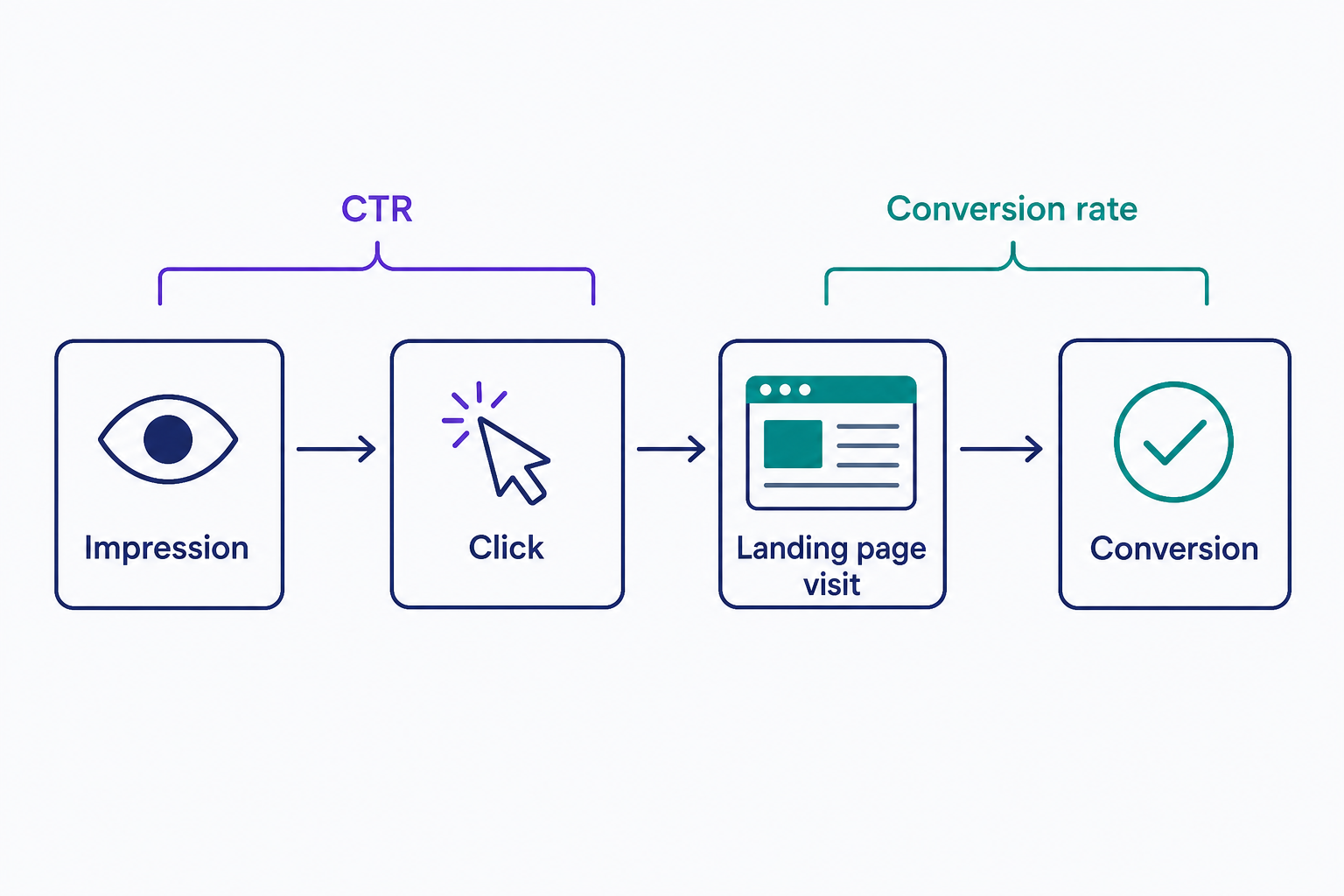
- CTR is the percentage of people who saw your link and clicked through to your page.
- Conversion rate is the percentage of visitors who complete a conversion after arriving, such as a purchase or a signup.
The pair is diagnostic. A high CTR with a low conversion rate usually means your title or ad promises something the landing page doesn't deliver. Closing that gap is the work of conversion rate optimization (CRO).
How to raise a low CTR
Work on what people see before the click. In organic search, that's your title tag and meta description: rewrite them to match the intent behind the query, not just the keyword. In paid search, tighten the match between the keyword, the ad copy, and the landing page. In email, test subject lines and where your main link sits in the message.
For the organic side, our guide to improving your website's click-through rate walks through 7 fixes in detail.
Where to find your CTR data
You don't have to calculate CTR yourself. Google Search Console shows organic CTR for every query and page in its Performance report. Google Ads lists a CTR for each ad and keyword in your account, and email platforms report a click rate per campaign. Check the number before and after each change so you know whether the new title or subject line actually worked.
Frequently Asked Questions
- Google hasn't confirmed it, but evidence suggests clicks matter: testimony at the 2023 US antitrust trial described Navboost, an internal Google system that refines results using people's past interactions with search results. Treat a higher CTR as a traffic win first; any ranking lift is a bonus.
- Open rate measures the percentage of delivered emails recipients opened; click rate measures the percentage that got a link click. Click rate is the more reliable signal: Apple Mail Privacy Protection automatically marks mail to Apple Mail users as opened, which inflates open rates.
- An impression is recorded every time your ad, listing, or link is shown, click or no click. One person can generate many impressions. Counting can vary too: Google's viewable CPM (vCPM) bidding charges only for viewable impressions, so check your platform's definition before comparing numbers.
Professional SEO Services
Our Pro Services team will help you rank higher and get found online. Let us take the guesswork out of growing your website traffic with SEO.
SEO Services