What is a Search Engine?
A search engine is a program that finds and ranks relevant web pages from its index, a database of content it has crawled from the web, in response to a search query. The best-known example is Google, which orders results by their relevance to the user’s keywords and other ranking signals.
More About Search Engines
Popular search engines include Google, Bing, Yahoo, Yandex, Baidu, and DuckDuckGo. They're far from equal in reach: per StatCounter Global Stats' tracking of worldwide search usage, Google held 91.31% of searches in July 2026, with Bing a distant second at 4.47%. That gap is why search engine optimization in practice mostly means optimizing for Google.
These websites use complex algorithms, revised through regular algorithm updates, to estimate the relevance and value of web pages as they pertain to the search query.
How search engines work
Google's How Google Search Works documentation breaks the process into 3 stages, and the other major engines follow the same model:
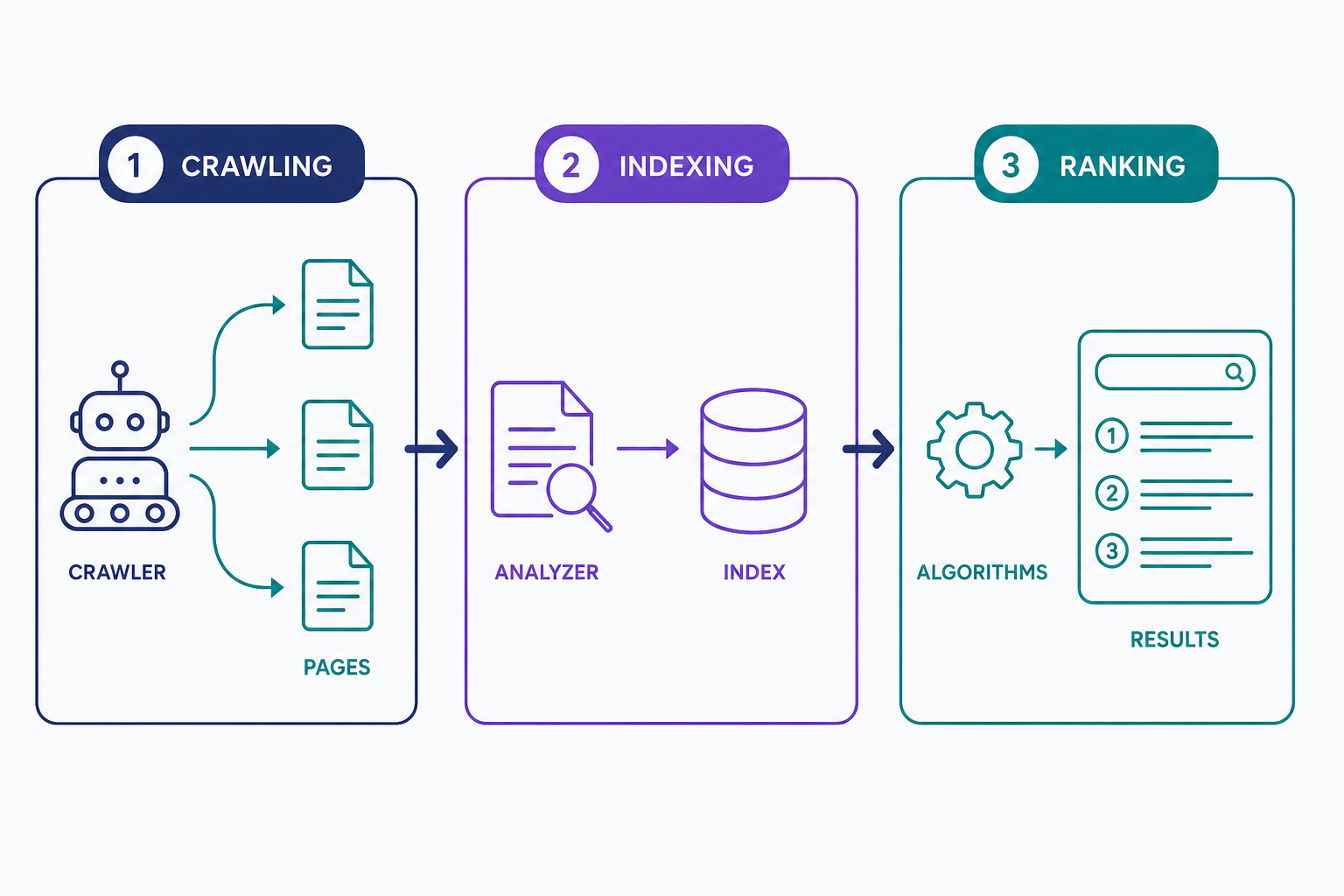
- Crawling: automated programs called crawlers follow links from page to page, exploring the web to find new and updated content.
- Indexing: the engine analyzes each page it fetches and stores it in its index, a database of all the content it has crawled.
- Ranking: when someone searches, algorithms sort the indexed pages by how well they match the searcher's keywords and hundreds of other signals, then serve results in that order.
The sequence matters. A page that's never crawled can't be indexed, and a page that isn't indexed can't rank, no matter how good it is. Engines also cap how many pages they'll fetch from one site in a given period, a limit known as the site's crawl budget.
Search engine vs. web browser
They're different tools that often get mixed up:
- A web browser (Chrome, Firefox, Safari) is an application on your device that displays web pages.
- A search engine (Google, Bing, DuckDuckGo) is a website you open inside that browser to find pages.
So Chrome is a browser, and Google Search is a search engine that Chrome loads like any other website. One displays pages; the other finds them.
Getting your site into search results
Search engines are the main way people find websites, so a site that isn't crawled and indexed is invisible in results. Crawlers discover pages by following links from pages they already know or by reading a sitemap you submit; most pages in Google's results were never submitted by hand.
Start by verifying your site in Google Search Console and submitting a sitemap there. Once your pages are indexed, SEO (search engine optimization) is the ongoing work of improving where they rank in the unpaid, organic search listings.
Frequently Asked Questions
- Mostly through advertising. Search engines are free to use because they sell ads against queries: sponsored results that appear above or beside the unpaid, organic listings. Paying for that placement is called search engine marketing (SEM).
- Not exactly. AI answer engines (ChatGPT search, Perplexity) and Google's AI Overviews compose a direct answer instead of listing links, but they still depend on crawled and indexed web content. If search engines can't see your site, neither can they; our guide to AI search covers the fix.
- Add a noindex meta tag or header to the page. Blocking it in robots.txt isn't enough: Google's documentation warns that a blocked crawler never sees the noindex rule, so the page can still appear if other sites link to it.
Professional SEO Services
Our Pro Services team will help you rank higher and get found online. Let us take the guesswork out of growing your website traffic with SEO.
SEO Services