What Is a Domain Registry?
A domain registry is the organization that operates a top-level domain (TLD), sets its rules, and maintains the authoritative database of every name registered under it, including each name’s sponsoring registrar and nameservers. ICANN-contracted generic TLD registries such as Verisign (.com, .net) sell registrations wholesale through accredited registrars; country-code TLD registries choose their own sales models.
More About Domain Registries
A domain registry keeps the authoritative record for its top-level domain (TLD): every registered domain name, its sponsoring registrar, and its nameservers. For thin registries like .com and .net, that's the whole record. Verisign, which runs both, doesn't collect or hold registrant contact details at all; those stay with the registrar you bought the name from.
The registry also sets the rules for its TLD, such as who may register a name and what registrars pay at wholesale. ICANN-contracted registries for generic TLDs (gTLDs) like .com don't sell to the public; they work through domain registrars, which sell registrations to individuals and companies. Country-code registries aren't bound by that model and set their own sales arrangements.
How a domain registry works
The registry maintains its TLD's zone, the master list the DNS consults to find which nameservers answer for each name. When the registry adds a domain to that zone, the domain can start resolving; when it removes one, the domain goes dark. The same registry database is what public WHOIS and RDAP lookups for the TLD return.
Registries operate at one level only: names registered directly under the TLD. Subdomains like blog.example.com are created by each domain's owner in their own DNS zone, and the registry never sees them.
Registries for generic TLDs also accept registrations only from ICANN-accredited registrars, never from you directly. The split is deliberate: one operator keeps the TLD's database and nameservers running, while thousands of registrars compete on price and support.
Registry vs. registrar vs. registrant
Three similar words, three different jobs:
- Registry: the wholesaler. It operates a TLD's database and zone. Verisign is the registry for .com and .net.
- Registrar: the retailer. An ICANN-accredited company that sells registrations to the public and manages them for customers. DreamHost is one.
- Registrant: the owner of record. The person or company named on the registration: you.
A .com registration, step by step
Say you register example.com through a registrar. Three things happen:
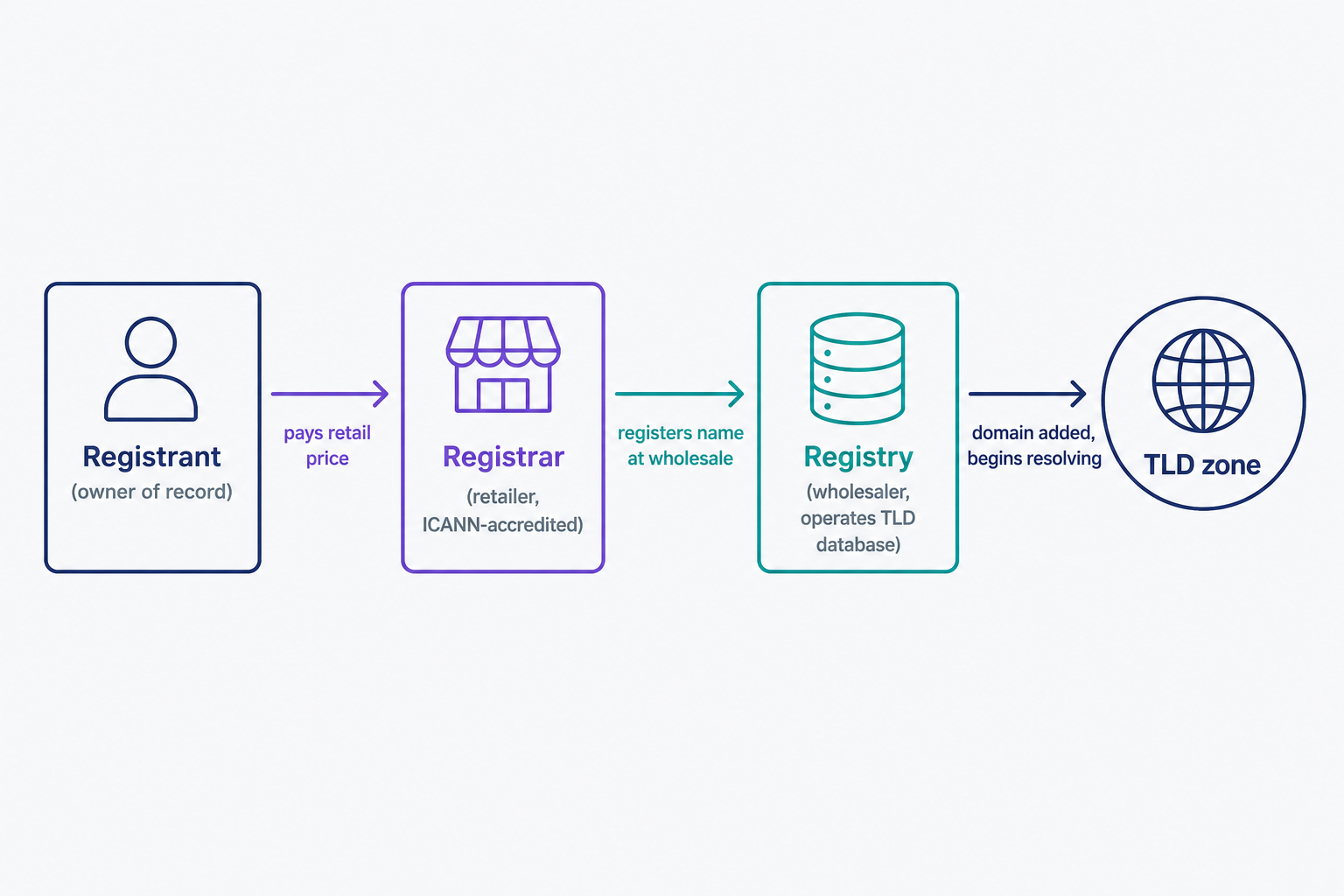
- You pay the registrar its retail price for the name.
- The registrar registers the name in the registry run by Verisign, the registry operator for .com and .net, and pays the wholesale registry fee: $10.26 per year as of August 2026, rising to $10.97 on November 1, 2026, an increase Verisign announced on April 23, 2026.
- Verisign adds example.com to the .com zone, and the domain can begin resolving.
That wholesale fee is the floor under every registrar's .com pricing, which is why renewal prices across the industry tend to rise together after a registry increase. The channel also runs one way only: Verisign doesn't sell names to the public, and it works with roughly 3,000 ICANN-accredited registrars.
Who oversees domain registries
Registries for generic top-level domains operate under registry agreements with ICANN; the pricing provisions in Verisign's .com agreement govern the wholesale fee above. A registry can't launch a new extension on its own, either. New gTLDs go through ICANN's New gTLD Program: an organization applies for the right to operate one, and the 2026 application window is open through August 12, 2026.
Country-code TLDs (ccTLDs) like .uk and .de work differently. Each ccTLD registry is appointed nationally and sets its own rules, prices, and sales model, so don't assume .com's terms carry over. Check the policy for the extension you're buying, or ask your registrar.
Examples of domain registries
Every domain extension has exactly one registry behind it. A few you'll actually meet:
- Verisign runs .com and .net, which ended the first quarter of 2026 with 176.1 million registrations between them. It also operates .cc and .name.
- Public Interest Registry (PIR), a nonprofit, runs .org and manages more than 11 million domains.
- Nominet runs the UK's national registry, including .uk and .co.uk.
Can you buy a domain directly from the registry?
No, not for gTLDs. Names in .com and other gTLDs are registered through ICANN-accredited registrars or their resellers, and registries like Verisign don't take retail customers. In practice, that means you compare registrars, not registries. The registry sets the wholesale floor and the TLD's rules; your registrar sets the retail price, renewal terms, and the support you'll actually deal with. The .com you buy anywhere ends up as the same entry in the same Verisign database. When you're ready, register or transfer the name through a registrar and let it handle the registry side.
Frequently Asked Questions
- No. ICANN doesn't operate any TLD. It accredits registrars and signs registry agreements with operators like Verisign, which runs .com under an ICANN contract. Think of ICANN as the coordinator, registries as the database operators, and registrars as the sellers.
- A security hold applied at the registry rather than the registrar. Transfers, deletions, and nameserver changes are blocked until the registry verifies the request out of band, such as by phone. Registrars offer it for high-value domains, usually as a paid add-on.
- A thin registry stores only each domain's name, sponsoring registrar, and nameservers; registrant contact details stay with the registrar. A thick registry also holds registrant data supplied by registrars. Verisign runs .com and .net thin, while its .name registry may hold registrant information.
Domain Registration
Search for the perfect domain name and register yours before someone else does! Click below to check availability and see special offers.
Domain Names