What is a gTLD?
A generic top-level domain (gTLD) is a domain extension, such as .com, .org, or .net, that isn’t tied to a specific country or territory. Since 2012, ICANN’s New gTLD Program has added more than 1,200 extensions like .bank, .berlin, and .pizza. ICANN coordinates the rules for registering domain names under all gTLDs.
More About gTLDs
The first gTLDs (.com, .edu, .gov, .mil, and .org) were defined in October 1984 in RFC 920 to categorize the organizations registering domain names: commercial, educational, governmental, and military. That was years before the first website existed.
The three gTLD categories
IANA's root zone database sorts every gTLD into one of three groups:
- Generic (.com, .net, .org, and most newer extensions): open to anyone in most cases, though some registries, like brand TLDs, set their own limits on who can register.
- Generic-restricted (.biz and .pro): launched with eligibility rules that have since loosened. ICANN removed .pro's registration restrictions when it renewed the registry agreement in 2015, so anyone can register a .pro domain today.
- Sponsored (.edu, .gov, .mil, and a handful of others): limited to a defined community. Only verified U.S.-based government organizations can register .gov, and .mil is sponsored by the U.S. Department of Defense.
One oddball isn't a gTLD at all: .arpa is the Internet's infrastructure TLD, administered by IANA under Internet Architecture Board guidance and reserved exclusively for technical uses such as reverse IP-address lookups (in-addr.arpa, ip6.arpa) and mapping phone numbers to URIs (e164.arpa).
The new gTLD expansion
New gTLDs were rare for decades. That changed in 2012, when ICANN's New gTLD Program opened the root zone to new extensions: the round drew 1,930 applications and has introduced 1,241 new gTLDs into the Internet as of June 30, 2026 (ICANN program statistics), including brand extensions like .microsoft and .sky, geographic ones like .berlin and .africa, and general terms like .bank and .eco.
A second expansion is happening right now. The 2026 Round application window opened on April 30, 2026, and closes on August 12, 2026. This round accepts applications in 27 scripts, including Arabic, Chinese, Devanagari, and Thai, so the next wave of gTLDs will serve far more languages.
How gTLDs are governed
ICANN, the nonprofit that coordinates the Domain Name System, decides which gTLDs exist and contracts a registry operator to run each one, while IANA's root zone database records every TLD and its type. You won't deal with either to put a site online: domain registrars handle individual registrations under the open gTLDs.
gTLD vs. ccTLD
Every gTLD is a TLD, but not every TLD is generic. TLD is the umbrella term; gTLD and ccTLD are the two main categories within it, and the split matters when you register:
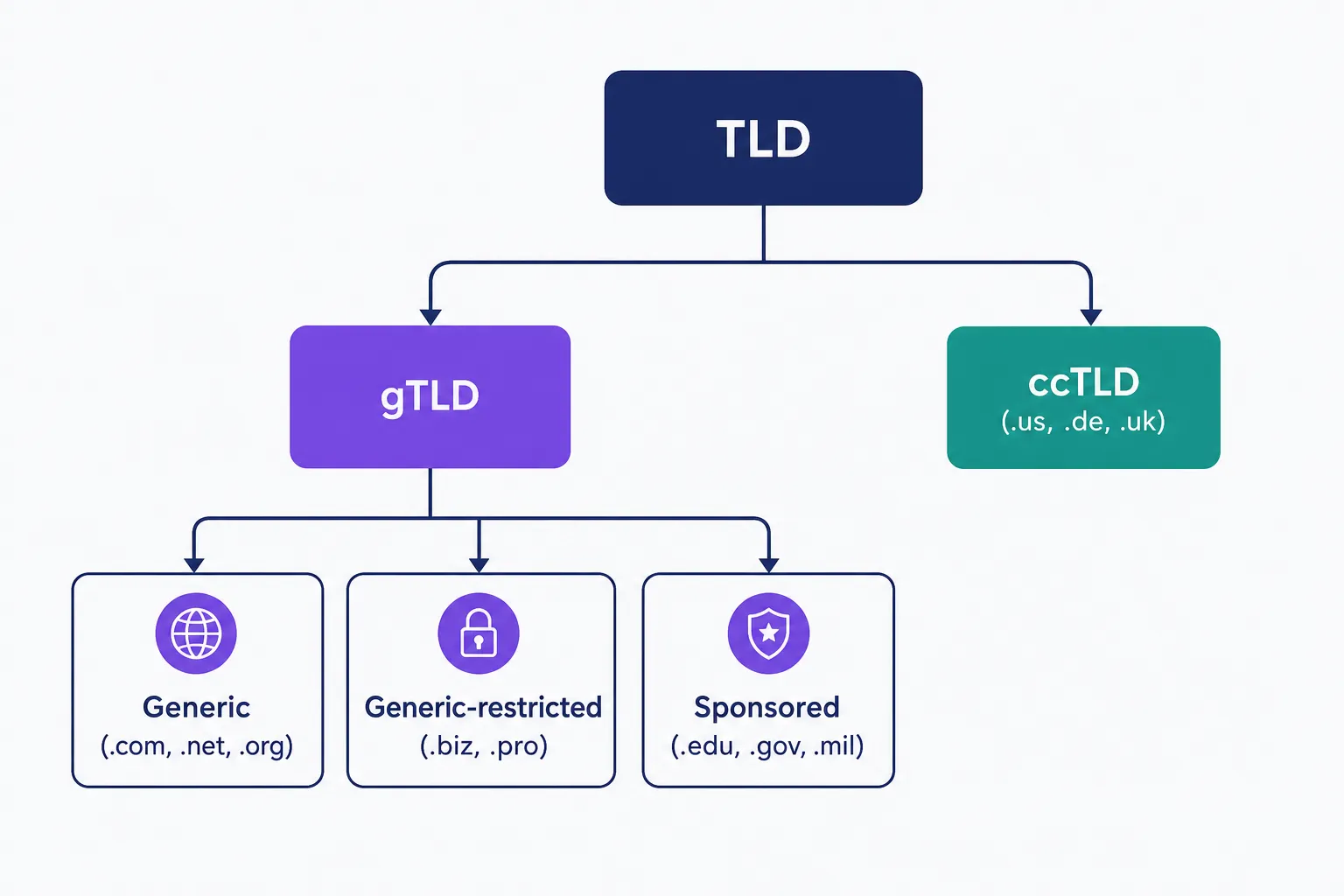
- gTLDs are extensions of three or more characters (.com, .pizza), and most are open to registrants anywhere in the world; sponsored gTLDs are the main exception.
- ccTLDs are two-letter extensions assigned to countries and territories (.us, .de, .uk). Each country sets its own rules, and some ccTLDs carry residency requirements.
Choosing a gTLD
For most sites, .com is still the safest default for recall and trust. A newer gTLD works when the .com you want is taken and the extension matches what you do: a bank can use .bank, a Berlin business can use .berlin. A ccTLD fits when one country is your primary audience, or when you run a separate site for each market; check that extension's eligibility rules before you commit. Whichever way you lean, the domain extension becomes part of your brand, so compare a few before you buy. Our guide to choosing a domain extension walks through the trade-offs.
Frequently Asked Questions
- No ranking effect from the extension itself. Google's Search Central blog said in July 2015 that keywords in a TLD do not give any advantage or disadvantage in search. Visitor trust and recall still favor familiar extensions, so weigh branding separately from SEO.
- Yes, by applying during an ICANN application round; the current window closes August 12, 2026, through ICANN's TLD Application Management System. Be clear about the commitment: you'd be operating a registry that runs the whole extension, not registering a single domain name.
- Through an ICANN-accredited domain registrar that offers your chosen gTLD; not every registrar carries every extension. Before you register, search the name to confirm it's available and check the registry's eligibility rules, since some extensions verify who can register.
- Each gTLD's registry sets its own wholesale price, so registration and renewal prices vary widely by extension. Always check the renewal price, not just the first-year offer, before you commit. Our domain extension guide covers how to weigh price against fit.
Domain Registration
Search for the perfect domain name and register yours before someone else does! Click below to check availability and see special offers.
Domain Names