What is Machine Learning?
Machine learning (ML) is a branch of artificial intelligence (AI) in which algorithms learn patterns from training data, then make predictions or decisions about new data without being explicitly programmed for each task. Trained ML models power image recognition, translation, spam filters, and search ranking systems like Google’s RankBrain.
More About Machine Learning
How machine learning works
Machine learning happens in two phases: training and inference. First, an algorithm processes example data and learns the patterns in it. The result is a model. Then that model makes predictions or decisions about new data it has never seen. Generalization is the goal: a model is only useful if the patterns it learned from examples hold up in the real world.
A spam filter is a classic example. Train it on thousands of emails that humans have labeled spam or not spam, and it learns which features predict junk mail, like suspicious links or telltale phrasing. It can then flag new messages it was never shown. Nobody wrote a rule for every spammer trick; the model derived its rules from the data.
Types of machine learning
Machine learning approaches are grouped by how the model is trained. The 4 main training methods are:
- Supervised learning: the model learns from labeled examples, like emails already marked spam or not spam.
- Unsupervised learning: the model finds patterns in unlabeled data on its own, like grouping customers by purchase behavior.
- Semi-supervised learning: a mix of both, where a small labeled dataset guides learning across a much larger unlabeled one.
- Reinforcement learning: the model learns by trial and error, adjusting its behavior to earn rewards for good decisions.
Deep learning often gets named alongside these, but it isn't a fifth sibling: it's a subset of machine learning built on multi-layer artificial neural networks. Everyday machine learning applications include chatbots, translation software, image recognition, and the recommendation engines that rank social media feeds by predicting what you'll engage with.
AI vs. machine learning vs. deep learning
The 3 terms nest inside each other, broadest to most specific:
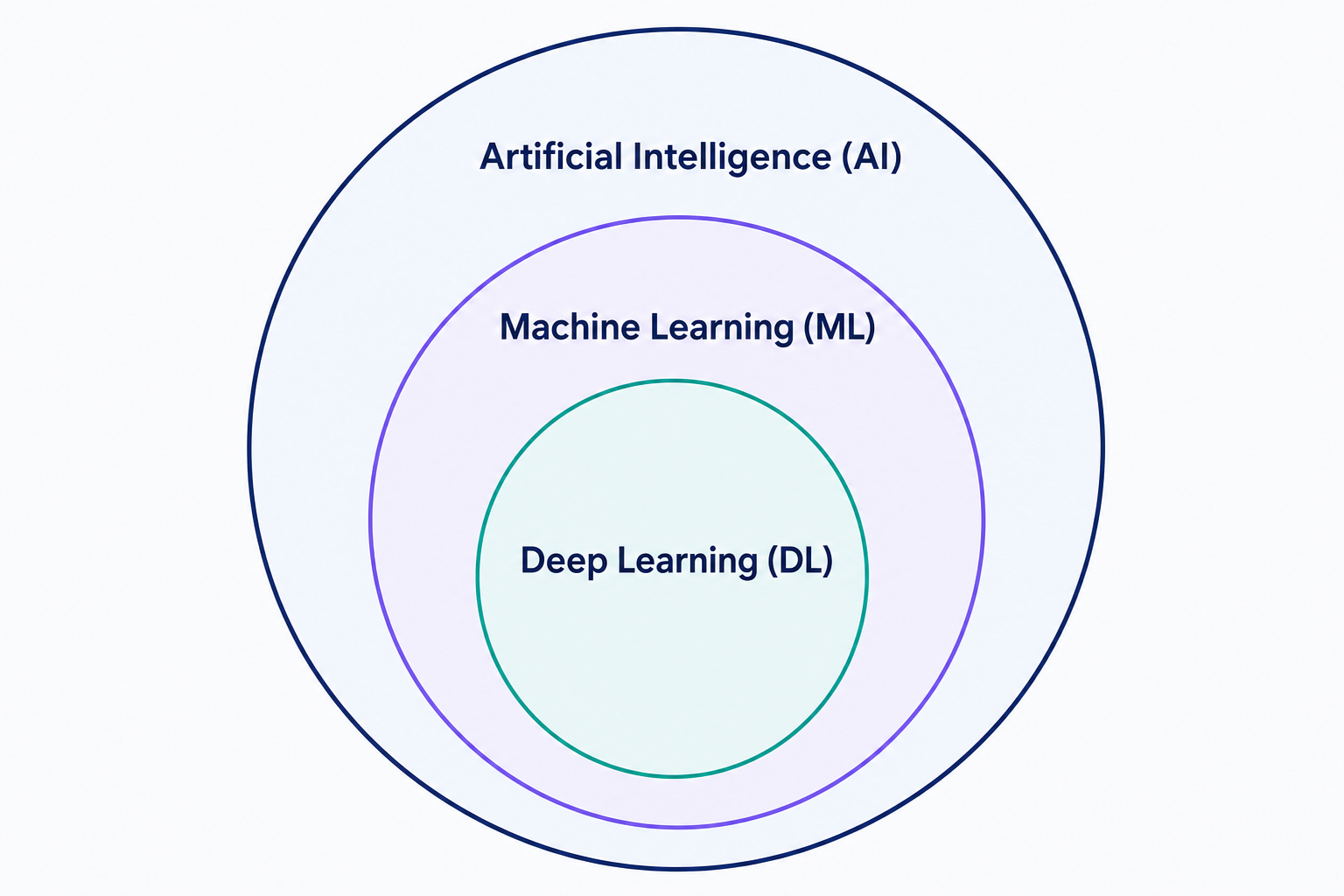
- Artificial intelligence (AI) is the broadest field: any system that exhibits intelligent behavior, whether it learns or follows hand-written rules.
- Machine learning (ML) is the subset of AI that learns patterns from data instead of relying on hard-coded instructions. It's the backbone of most modern AI systems, from forecasting models to generative AI tools.
- Deep learning (DL) is the subset of machine learning driven by multi-layer neural networks, which have become the state-of-the-art architecture in nearly every domain where AI is used.
Picture 3 nested circles: AI is the outer ring, machine learning sits inside it, and deep learning sits at the center.
When machine learning goes wrong
Machine learning fails in 3 predictable ways: overfitting, biased training data, and model drift.
- Overfitting: the model fits its training data so closely that it can't make accurate predictions about anything else. It memorized its examples, noise included, instead of learning general patterns. The standard check is holding out part of your data as a test set: low error in training plus high error on the test set signals overfitting.
- Biased training data: a model absorbs whatever slant its examples carry. A translation system can learn to associate certain languages with gender stereotypes, for instance. Before relying on a model, check its results across the groups and cases it will actually serve.
- Model drift: a deployed model's performance decays when incoming data stops matching the data it was trained on, as IBM's model drift explainer documents. Spam filtering is the classic case: spammers keep changing tactics, so a static filter grows useless. Monitor deployed models against current data, and retrain when accuracy drops.
Machine learning in SEO
Machine learning is central to search engine optimization because Google ranks pages with it. According to Google's February 2022 explainer, Search runs on hundreds of algorithms and machine learning models. RankBrain, launched in 2015 as the first deep learning system in Search, relates the words in a query to real-world concepts, so a relevant page can rank even when it doesn't contain the exact words a searcher typed. Neural matching (2018) matches the underlying concepts in queries and pages, and BERT (2019) interprets how a combination of words expresses meaning and intent. That learning capacity matters because 15% of the searches Google sees each day are entirely new.
The practical takeaway: write content that answers searcher intent instead of chasing exact-match keywords. Systems that rank by meaning reward pages that cover a topic clearly, not pages that repeat a phrase.
Many marketing tools use machine learning too, generating content topics, keyword ideas, and even full article drafts. Treat those drafts as raw material a human must review. Publishing unreviewed machine-generated articles at scale can violate Google's spam policies, which target content produced to manipulate rankings, and violating sites may rank lower or disappear from results entirely. For a workflow that keeps AI-assisted content credible, see our guide to scaling content with AI.
Frequently Asked Questions
- Yes. ChatGPT runs on a large language model trained on massive amounts of text, and large language models and other generative AI tools are machine learning models. Every ChatGPT answer comes from a trained model, not a hand-written script.
- No. You don't have to build or train anything to benefit. Just know the consequence: Google's ranking systems learn meaning from data, so clear pages that answer real questions beat pages engineered around a single phrase. Machine learning knowledge is optional; clarity isn't.
- They're built differently. A conventional program applies rules a programmer wrote explicitly; a machine learning model fits its parameters to example data instead. Either can be deterministic. A trained model changes only if it's retrained or keeps learning from new data; otherwise it stays fixed while the world moves.
Professional SEO Services
Our Pro Services team will help you rank higher and get found online. Let us take the guesswork out of growing your website traffic with SEO.
SEO Services