What is a Domain Drop List?
A drop list is a daily list of expired domain names scheduled to be deleted, or “dropped,” from a domain registry and released for public registration. Domain investors watch drop lists to spot valuable names before they drop, then use backorder or drop-catching services to register the names the instant they become available.
More About Drop Lists
A drop list, sometimes called a pending-delete list, is the daily list of expired domains a registry is about to delete and release for re-registration. Names land on it after their owners fail to renew the registration and the grace period runs out. Most entries are in pending delete, the final stage, when nobody, including the previous owner, can renew or restore the name.
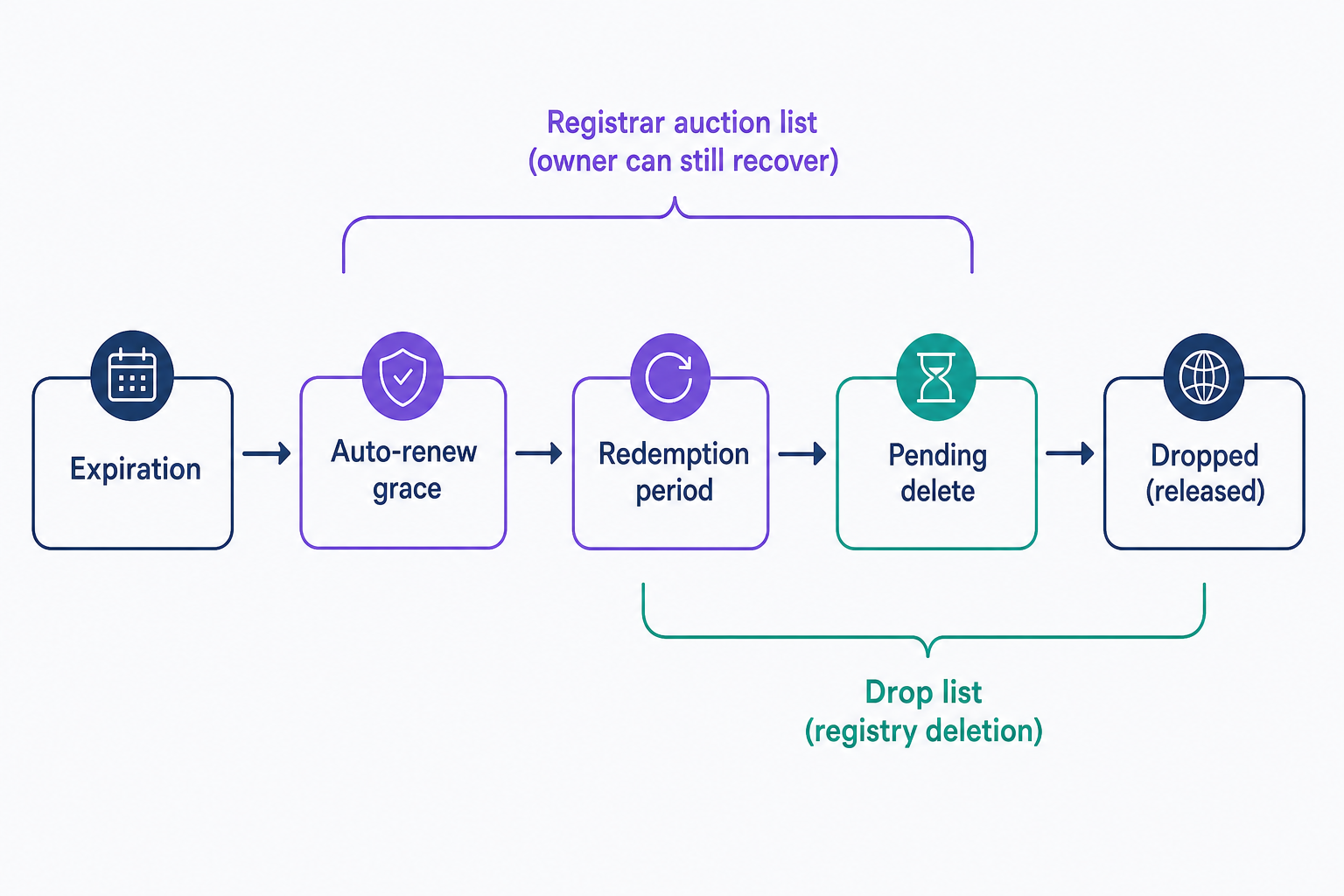
Each entry typically shows the domain name, its WHOIS status (redemptionPeriod or pendingDelete), and its scheduled drop date. Two sets of rules shape that date for gTLDs like .com. ICANN’s Expired Registration Recovery Policy (last updated February 2024) covers the registrar’s side: owners can keep renewing an expired name until the registrar deletes it, and registrars may delete at any time after expiration, typically within the registry’s 0-to-45-day auto-renew grace period. The same policy requires gTLD registries to hold every deleted name in a 30-day redemption grace period, and ICANN’s gTLD life cycle shows the final stage: about 5 days of pending delete. Add it up, and a .com typically drops 35 to 80 days after it expires. Country-code extensions set their own timelines. Pending delete is short, so the names at the top of a list are only days from release.
When a listed domain drops
When pending delete ends, the registry deletes the name, and it generally becomes available first come, first served through registrars that support that extension. The previous owner gets no priority. Pricing varies too: a released name may cost the normal registration fee, carry the registry’s premium pricing, or come with backorder or auction charges if you use a catching service to get it. In practice, drop-catching services race to submit registrations the second a batch of names is released, and a valuable name is usually gone within seconds. If several people backordered the same name through the same service, the service auctions it among those bidders.
Drop lists vs. auction lists
They cover opposite ends of the expiration timeline. An auction list is a registrar’s inventory of expiring names offered for sale during the grace and redemption windows, before deletion, while the original owner can still recover them. Those auctions are registrar add-ons, not part of the registry’s deletion process. A drop list tracks names the registry itself is about to release to everyone. A name that sells at a registrar’s expiry auction gets renewed for its new owner and never reaches the drop.
Where drop lists come from
It depends on the extension. Nominet, the .uk registry, publishes a free public drop list every day as a compressed CSV listing each name and the exact time it becomes available. For .com and .net, third-party aggregators and drop-catching services compile daily lists from zone-file changes and WHOIS status checks. Access terms vary by provider, so check what’s free and what requires a subscription before you build a routine around one list.
Why domainers watch drop lists
Because a dropped name can be worth far more than a new registration. An aged domain may carry an existing backlink profile and residual traffic, or it may simply be a short, brandable name someone let lapse. Domainers register these names to develop them or resell them on the domain aftermarket, a practice known as domain flipping. Check a name’s history before building a brand on it, though: some dropped domains carry spam baggage instead of value.
How to use a drop list
Filter first, then pick your route. Raw lists are long, so domainers narrow them by drop date, WHOIS status, domain age, backlink profile, and traffic history before shortlisting anything.
- Check the WHOIS status. A “pendingDelete” status means the drop is about 5 days out at most; “redemptionPeriod” means up to about 35 days, and the owner can still restore the name.
- For a name you must have, place a backorder with one or more drop-catching services before the drop. Payment models vary by provider, so check whether you’ll pay an upfront fee, a fee only on a successful catch, a membership fee, or an auction price if other customers chase the same name.
- For a name nobody else is likely to chase, register it yourself the moment it drops, at any registrar that offers the extension.
Miss the catch, and your next chance at the name is the aftermarket, at whatever price the new owner sets. Decide your ceiling before the drop, not after.
Frequently Asked Questions
- No. Names still in the redemption period can be restored by their owner and removed from the next day’s list, and registrars auction some expiring names before they ever drop. Only names already in pendingDelete status are effectively certain to be released.
- For .com and .net, Verisign runs its daily deletion batch between about 2 and 3 p.m. Eastern, per WhoisFreaks (July 2026). The exact minute varies, which is why drop-catching services stand ready in advance. Country-code registries set their own daily schedules.
- No. The Spamhaus DROP (Don’t Route Or Peer) list is a security blocklist of IP ranges controlled by spam and cybercrime operations; firewalls use it to block traffic. A domain drop list tracks expired domain names about to be deleted and released. Same nickname, different jobs.
Domain Registration
Search for the perfect domain name and register yours before someone else does! Click below to check availability and see special offers.
Domain Names